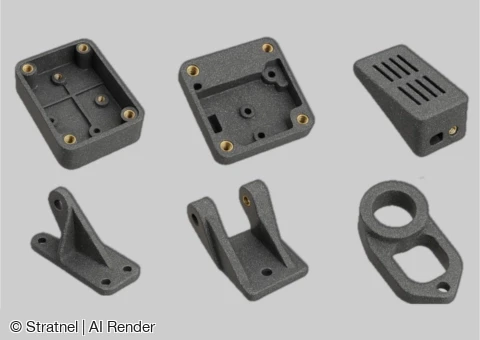
Vacuum casting uses silicone moulds made from 3D printed masters to deliver production-equivalent polyurethane parts in days — not months. Four material grades, run sizes from 10 to 50 parts per mould, and surface finish that replicates your master pattern down to the finest texture.
The process begins with a high-accuracy 3D printed master pattern — typically SLA for the best surface quality. Liquid silicone is poured around the master under vacuum, capturing every surface detail. Once cured, the silicone mould is cut open and the master removed. Liquid polyurethane is then mixed, poured into the mould, and cured under vacuum to eliminate air entrapment. Parts are demoulded, trimmed, and inspected. Each silicone mould typically yields 10–25 parts before it is replaced.

Vacuum casting occupies a specific and highly valuable window in the product development cycle — and in low-volume production.
Before committing to injection mould tooling, validate your design with production-equivalent parts. Fit, function, aesthetics — all testable with vacuum cast parts at a fraction of the tooling cost.
When your injection mould tooling is being made, vacuum casting keeps your production line moving. Parts are visually and mechanically equivalent — customers cannot tell the difference.
For products where volumes never justify a ₹5–20 lakh injection mould, vacuum casting is the permanent production solution — economical from 10 to a few hundred parts per year.
Presentation-quality parts for sales samples, trade shows, and investor demonstrations — indistinguishable from the production article, delivered in days. Test multiple colour options and surface finishes on real production-geometry parts before making tooling decisions.
For discontinued or low-demand products where tooling no longer exists, vacuum casting is the most economical way to maintain a spare parts supply.
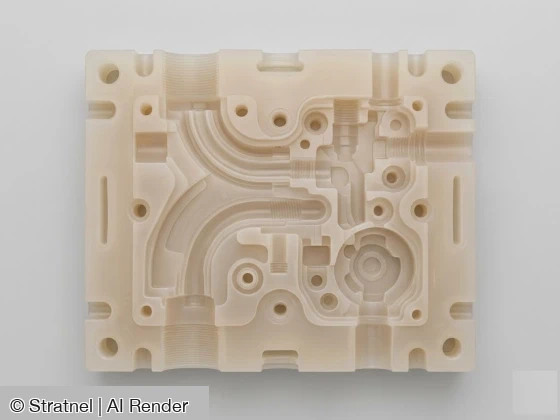
Seamlessly encapsulate threaded hardware, metal bushings, and structural inserts into polyurethane castings for high-strength, production-grade assemblies. Get exceptional mechanical and chemical bonding between rigid substrates and soft-touch elastomers without the high cost of hard tooling.
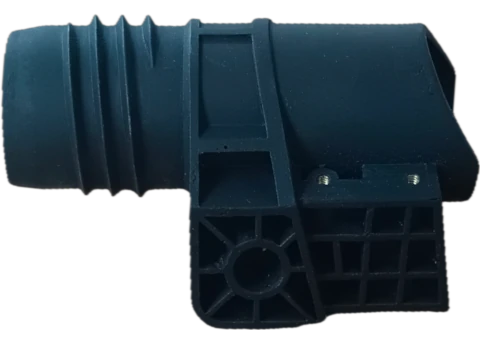
A standard rigid polyurethane engineered for vacuum casting — durable, dimensionally stable, and with good thermal and chemical resistance. Closely replicates the look, feel, and mechanical behaviour of injection moulded ABS. REACH compliant and RoHS 1 & 2 certified.
| Property | Value |
|---|---|
| Material resembling | ABS-like, comparable to opaque Polycarbonate |
| Material | Standard rigid polyurethane |
| Density (cured mix) | 1.14 g/cm³ |
| Pot life | 6–7 minutes |
| Demould time | ~45 minutes at 70°C |
| Compliance | REACH, RoHS 1 & 2, WEEE, ELVs |
| Surface finish | Replicates master — smooth, paintable, texture-matched |
| Run size | 10–25 parts per silicone mould |
| Best for | Housings, enclosures, structural components, functional prototypes, marketing samples |

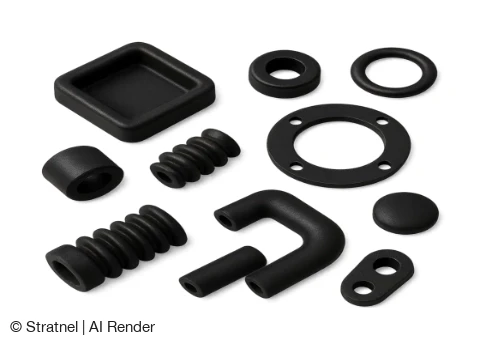
A low-viscosity flexible rubber system with fully adjustable Shore hardness — achieved by varying the ratio of the third component. This means a single material system can replicate anything from firm rubber to very soft gel, covering the full range of soft-touch and sealing applications. Translucent white, pigmentable to any colour.
| Property | Value |
|---|---|
| Material resembling | TPE-like |
| Shore Hardness | Tensile Strength | Elongation at Break |
|---|---|---|
| 90A | 17 MPa | 270% |
| 80A | 12 MPa | 260% |
| 70A | 8 MPa | 230% |
| 60A | 6 MPa | 290% |
| 50A | 5 MPa | 290% |
| 40A | 4 MPa | 310% |
| 30A | 3 MPa | 310% |
Overmoulding onto the standard rigid grade possible. Pigmentable to any colour. Curing at 70°C.

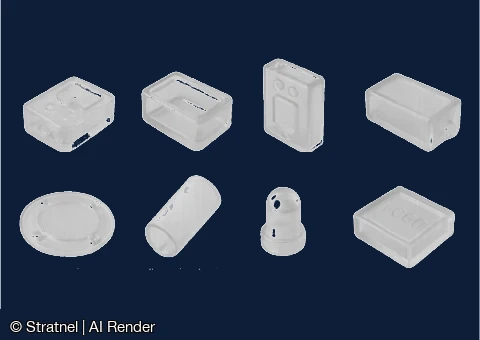
A colourless, optically transparent polyurethane with ABS-like mechanical strength — making it the ideal choice when both clarity and structural integrity are required. High transmissivity of 90.75%. Tintable to any colour while retaining transparency.
| Property | Value |
|---|---|
| Material resembling | Acrylic-like |
| Material | Colourless, optical-grade polyurethane |
| Shore hardness | 82D at 23°C — firm, ABS-like |
| Tensile strength | 58 MPa |
| Flexural strength | 99 MPa |
| Flexural modulus | 2400 MPa |
| Elongation at break | 25% |
| Heat deflection temperature | 72°C |
| Light transmissivity | 90.75% |
| Transparency | Near-optical for simple geometries — translucent for complex |
| Best for | Lenses, display windows, light covers, transparent enclosures |

A glass fibre reinforced rigid polyurethane — delivering significantly higher stiffness and modulus than standard rigid while retaining the same processing and surface quality. The right choice when structural rigidity matters and the weight or cost of metal is not justified.
| Property | Value |
|---|---|
| Material resembling | PBT-like |
| Material | Glass fibre reinforced rigid polyurethane |
| Density (cured) | 1.23 g/cm³ (vs 1.14 unfilled) |
| Flexural modulus | Up to 3500 MPa at 25% filler loading |
| Stiffness vs standard rigid | Significantly higher — glass fibre reinforced |
| Pot life | 7–8 minutes |
| Best for | Structural brackets, load-bearing enclosures, stiff housings, under-bonnet parts |

Vacuum casting serves industries where production quality is non-negotiable but volumes are too low to justify injection mould tooling.
Interior trim, HVAC components, dashboard elements, and under-bonnet housings — production-quality parts for pre-tooling validation and low-volume supply.
Packaging, product enclosures, and marketing samples indistinguishable from the production article — delivered in days for commercial presentations and launches.
Custom housings, covers, and structural brackets for machinery where volumes are low and hard tooling investment is difficult to justify.
Enclosures, bezels, and connector housings with production-quality finish — ideal for pre-production batches while injection tooling is in progress.
Instrument housings and equipment covers where a production-quality appearance is required for regulatory submission samples and clinical evaluation units.
Low-volume structural components, cabin fittings, and custom brackets — produced to production quality standards without the cost and lead time of hard tooling.
Detailed material datasheets are available upon request. To receive technical documentation for a specific material, please submit an enquiry with your application details.